
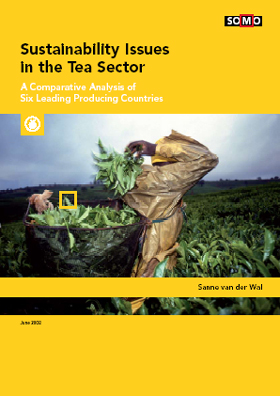
Falling tea prices affect working conditions
Working conditions of tea pickers worldwide are under pressure due to low prices and high production costs. This is one of the conclusions of the new SOMO report “Sustainability Issues in the Tea Sector” presented today.
The new SOMO report analyses the conditions in six of the most important tea producing countries: India, Sri Lanka, Vietnam, Indonesia, Kenya and Malawi. It shows that, as a result of oversupply leading to low market prices, for example, and high production costs, working conditions for tea pickers are under pressure. The constituents of this group, that represents the majority of the workforce, often have low job security and low income security, low wages, face discrimination along ethnic and gender lines and lack protective gear as well as adequate basic facilities such as proper housing, sometimes even drinking water and food. At the same time they have no way to improve working conditions because independent trade unions are ineffective, absent or not representing them because most of them are temporary workers. While tea production by smallholders is rising worldwide, their situation is often problematic because the prices they are paid for fresh tea leaves tend to be below the cost of production, among other factors. The sector’s environmental footprint is considerable, with reduced biodiversity as the result of habitat conversion, high energy consumption (mainly using logged timber) and a high application of pesticides in some countries.
Meanwhile, tea trade and distribution is dominated by a few international companies, such as Unilever (Lipton, PG Tips), Tata Tea (Tetley) and Sara Lee (Pickwick), that benefit from stable retail prices and, together with retailers, capture more than three quarters of the (Dutch) retail price. It was found that these tea companies are increasingly looking to address the problematic conditions in their supply chains through Corporate Social Responsibility (CSR). However, to date these strategies have not succeeded in adequately tackling many of these problems. With this comparative analysis of conditions, obstacles and opportunities in the tea industry and by making recommendations SOMO aims to contribute to a more sustainable tea sector.
Related news
-
Hungry for profits Published on:
 Vincent KiezebrinkPosted in category:Publication
Vincent Kiezebrink
Vincent KiezebrinkPosted in category:Publication
Vincent Kiezebrink
-
 Modern slavery is still lurking in your coffee cupPosted in category:News
 Joseph Wilde-RamsingPublished on:
 -
Bitter brew Published on:Posted in category:Publication